
Bushes and Shrubs
Bushes and Shrubs – bushes and dense vegetation for realistic terrain
Fine Bushes are designed for creating bushes, shrubs and dense three-dimensional vegetation on bases, dioramas and gaming terrain. Compared to low static grass or traditional grass tufts, they add more volume to the landscape and help create a natural transition between low vegetation, bushes and taller plants.
Bushes can be used in forests, along roads and buildings, at the edges of meadows, between rocks and in overgrown ruins. You can divide them into smaller irregular pieces and combine them with static grass, grass tufts, moss, leaves and other plants. By layering different types of vegetation, the finished landscape will look much more natural.
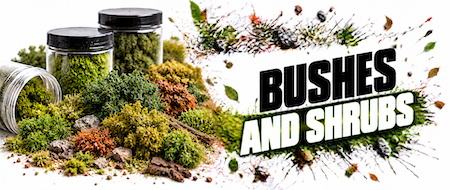
Fine Bushes create more prominent three-dimensional vegetation than ordinary grass. Use them as small bushes, shrubs or irregular patches of vegetation to add another layer of height to your terrain.
Bushes fit naturally between trees, around rocks and in transition areas between forests and open landscapes. Combining low moss, grass and taller bushes helps create a richer and more varied forest undergrowth.
Placing vegetation around building foundations, along walls and in the corners of ruins creates the impression of an environment gradually being reclaimed by nature. Bushes work especially well together with ivy, grass and other plants.
Use smaller pieces of bushes along paths, near rocks, fences and other obstacles. These areas tend to be more overgrown in nature, and irregular clusters of vegetation help make the terrain look more realistic.
On a miniature base, a single small bush is often enough to create a distinctive detail. On a larger diorama, you can create entire groups of shrubs and use different sizes to connect low vegetation with trees and other dominant elements of the scene.
The best results come from layering. Soil and rocks form the foundation, moss and static grass create the lowest vegetation, grass tufts form the middle layer, and Fine Bushes add the most prominent volume. Finally, you can add leaves and individual plants.
Do not use the vegetation as one large, uniform piece. Divide the material into several pieces of different sizes and arrange them in irregular clusters around rocks, trees, walls or the edges of paths. Use smaller pieces to create a transition into the surrounding grass and leave several larger pieces as the main bushes. For a more realistic result, combine different heights and textures of vegetation and leave some of the soil visible. This way, the bushes will not look like separate pieces of material placed on the terrain, but rather like a natural part of the entire landscape.


